
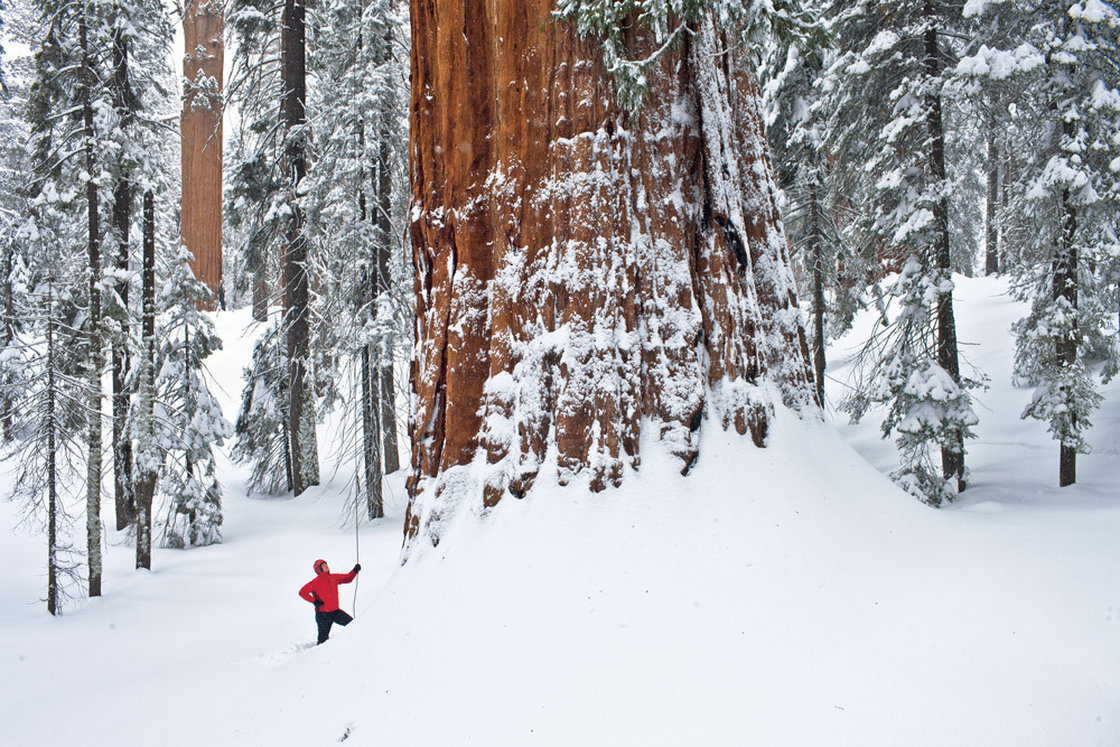
The President is a giant sequoia about 3,200 years old, 247 feet (75 m) tall and carrying an estimated two billion leaves. In 2012 National Geographic photographer Michael "Nick" Nichols and his team captured the whole tree, in snow, in a single portrait stitched together from 126 frames.

The President: facts about the giant sequoia
The President grows in the Giant Forest of Sequoia National Park, in California's Sierra Nevada, east of Visalia. It was named in 1923 after President Warren G. Harding.
- Height: about 247 ft (75 m).
- Base diameter: about 27 ft (8.2 m).
- Age: roughly 3,200 years, making it the oldest known living giant sequoia.
- Wood volume: about 54,000 cubic feet (1,500 m³) in the trunk plus some 9,000 cubic feet (250 m³) in its branches, as measured in 2012.
- Rank: the second-largest known tree in the world by wood volume, after its Giant Forest neighbour, the General Sherman. Two other sequoias have wider trunks, but none has a bigger crown.

How Nichols photographed the whole tree in 126 frames
A single frame from far enough away to fit a 247-foot tree would lose the detail of its bark and branches. Nichols's solution was a mosaic. His team hoisted a camera rig into the air and photographed the tree in sections, then combined 126 images into one composite portrait.
The finished picture shows the President cloaked in the snows of the Sierra Nevada, with climbers among the branches giving a sense of scale. National Geographic followed up in its December 2012 issue with a large tear-out of the President, and a video of the shoot appeared in the magazine's digital edition.

Steve Sillett's research: old trees keep growing
The portrait accompanied the work of Steve Sillett of Humboldt State University and his colleagues, who measure giant trees by climbing them. Their work confirmed the President's ranking, and it produced a bigger finding: giant sequoias keep growing fast in old age. A tree like the President adds more wood each year than much younger trees.
That challenges a long-held idea in forestry that old trees are past their productive peak, an assumption that has been used to justify cutting forests on short rotations.
Watch: a sequoia in a snowstorm
Visiting the Giant Forest in Sequoia National Park
The Giant Forest sits at more than 6,000 ft (1,800 m) and covers about 1,880 acres. Five of the ten most massive trees on Earth grow here, including the General Sherman, the largest known tree by volume. The easy 2-mile (3.2 km) Congress Trail leads to the House and Senate, the two parts of the Congress Group of sequoias between the General Sherman and the Giant Forest Museum, and the Generals Highway links the grove with General Grant Grove in neighbouring Kings Canyon National Park.
Snow transforms the grove in winter, as Nichols's portrait shows. Check the park's road conditions before a winter drive, as storms can close or restrict mountain roads.
For a look at the opposite end of the scale, see a resourceful camera setup for the opposite scale, or read about trees and their winter adaptations.
Related reading
- Niccolò Bonfadini’s Sentinels of the Arctic in Finnish Lapland
- Tateyama’s Snow Corridor and the Alpine Route
- Inside Kamchatka’s Mutnovsky Ice Cave
- Lightning in Slow Motion: Branches and Bright Pulses
- Strokkur Geyser: From a Blue Dome to a Column of Spray
- Silverthorne’s Ice Castle: Tunnels, Arches and Frozen Light
Sources
- NPR: One Photo, 126 Frames, 2 Billion Leaves, 247 Feet
- PetaPixel: Capturing the second-largest tree in the world in a single image
- Wikipedia: President (tree)
- Wikipedia: Giant Forest
- Video: Magnificent Giant Tree: Sequoia in a Snowstorm | National Geographic. Photographs: Michael Nichols / National Geographic.


really amazing.
ReplyDeleteI felt so lucky, because I had been hugging this amazing big tree.
ReplyDeletepeople who cut these magnificent trees down should be condemned to be chopped to pieces over and over for eternity
ReplyDelete'it's yearly output of wood is..' - everything living counted as some commodity
ReplyDelete