
Spectacular GoPro Footage Of Polar Bears Searching For Ice
Scanning the Arctic Ocean for sea ice is a regular adventure for polar bears, but never before have we been able to see them in action quite like this.
Arctic Bear Productions went all out for their latest documentary about polar bears.
Adam Ravetch found a pack of polar bears, and strapped a go-pro to the closest one. The results are nothing short of amazing. But who is Adam Ravetch, the seemingly crazy man responsible for attaching a go-pro to a polar bear?!
He’s an award winning filmmaker, an avid scuba diver, and a marine naturalist. And instead of crazy he’s actually pretty genius. Adam is on a mission to show the connections animals and humans share—after all, they are not as different from us as we sometimes think.
For over 2 decades Adam has suffered the harsh conditions of polar environments, swimming with prehistoric Ice-sharks, and being swarmed by a team of 2,000-pound walruses—yes, the ones with the huge sharp tusks!
Throughout all of his wild adventures he has collected some of the most raw and breathtaking footage of arctic animals, including the amazing video of the polar bears looking for sea ice. And since he used a go-pro to capture the whole thing, we are given an amazing first-hand perspective of polar bear life.
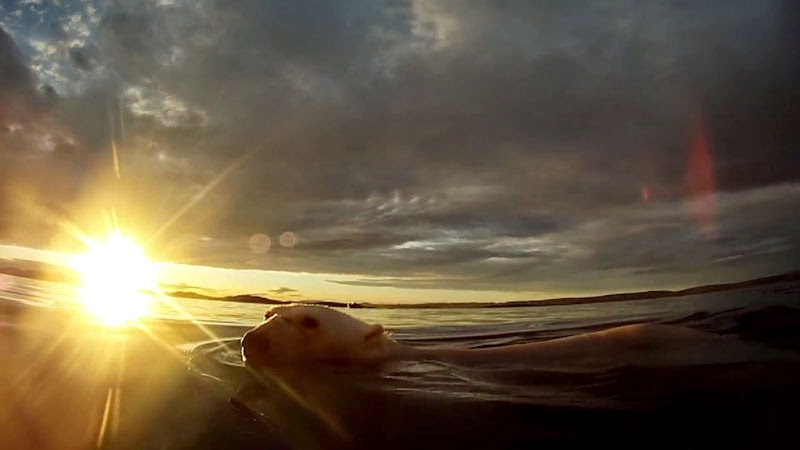
My favorite part of the bear-perspective footage is when one of the bears up ahead looks back at the bear wearing the go-pro, and you can just feel the love. By coming in from the viewpoint of the bear, you feel like you are a part of the family, making the video so much more special.
Looking at the bears’ big feet as they gracefully move through the water is also simply incredible. You see the bears following one another, switching up where they are in the line, just swimming and swimming for what seems like an entire day.
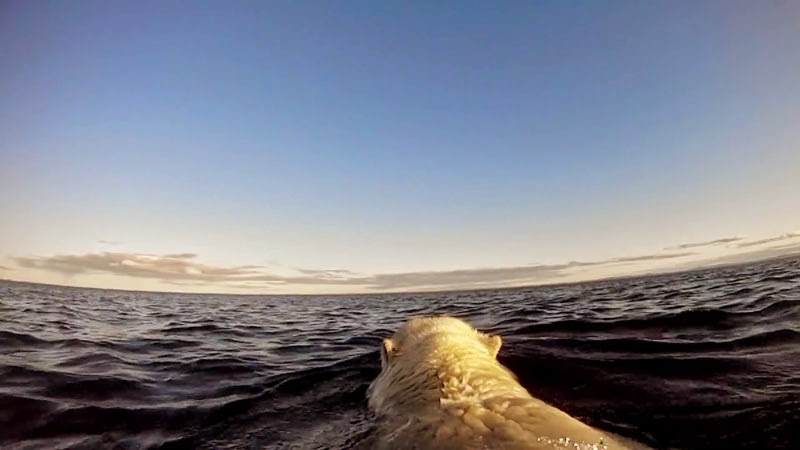
And this is where it gets heartbreaking. They swim and swim like this in hopes of getting a meal for their hungry bellies. They are looking for sea ice, a necessity to life because sea lions (aka dinner) frolic here. Due to global warming the amount of sea ice that is available is getting smaller and smaller.
Forcing many polar bears to travel all this way for nothing. Those that do find sea ice risk being so far out no sea lions are present. Polar bears with this issue live in what scientists have termed “Divergent Ice Eco Regions”.

There are 19 documented populations of polar bears that currently exist; of these 19 populations there are four different classifications for the level of ice shortage they face. “Seasonal Ice Eco-Regions” polar bears are the most endangered because in these regions there is only ice in the winter, and winters are getting shorter.
This is causing polar bears to go longer and longer without a meal, relying on their fat resources instead of food.

The best off are the polar bear groups living in the “Basin Convergent Eco Regions.” Here, ice still collects along the shore, offering polar bears access to food all year long.

They might be safe and well fed now, but it is predicted that these polar bears will experience the same sea ice shortages within the next 75 years.

Within the next 100 years it is predicted that ALL polar bears will be faced with ice shortage. The only way to save the polar bears is to reduce the number of greenhouse gasses we release. You can do a number of things in order to reduce your own emissions, such as be mindful of your electricity use, buy local produce, and walk or ride a bike when you can. It’s the little things that add up, do it for the polar bears!

Source: Earth Porn
Arctic Bear Productions went all out for their latest documentary about polar bears.
Adam Ravetch found a pack of polar bears, and strapped a go-pro to the closest one. The results are nothing short of amazing. But who is Adam Ravetch, the seemingly crazy man responsible for attaching a go-pro to a polar bear?!
He’s an award winning filmmaker, an avid scuba diver, and a marine naturalist. And instead of crazy he’s actually pretty genius. Adam is on a mission to show the connections animals and humans share—after all, they are not as different from us as we sometimes think.
For over 2 decades Adam has suffered the harsh conditions of polar environments, swimming with prehistoric Ice-sharks, and being swarmed by a team of 2,000-pound walruses—yes, the ones with the huge sharp tusks!
Throughout all of his wild adventures he has collected some of the most raw and breathtaking footage of arctic animals, including the amazing video of the polar bears looking for sea ice. And since he used a go-pro to capture the whole thing, we are given an amazing first-hand perspective of polar bear life.
My favorite part of the bear-perspective footage is when one of the bears up ahead looks back at the bear wearing the go-pro, and you can just feel the love. By coming in from the viewpoint of the bear, you feel like you are a part of the family, making the video so much more special.
Looking at the bears’ big feet as they gracefully move through the water is also simply incredible. You see the bears following one another, switching up where they are in the line, just swimming and swimming for what seems like an entire day.
And this is where it gets heartbreaking. They swim and swim like this in hopes of getting a meal for their hungry bellies. They are looking for sea ice, a necessity to life because sea lions (aka dinner) frolic here. Due to global warming the amount of sea ice that is available is getting smaller and smaller.
Forcing many polar bears to travel all this way for nothing. Those that do find sea ice risk being so far out no sea lions are present. Polar bears with this issue live in what scientists have termed “Divergent Ice Eco Regions”.
There are 19 documented populations of polar bears that currently exist; of these 19 populations there are four different classifications for the level of ice shortage they face. “Seasonal Ice Eco-Regions” polar bears are the most endangered because in these regions there is only ice in the winter, and winters are getting shorter.
This is causing polar bears to go longer and longer without a meal, relying on their fat resources instead of food.
The best off are the polar bear groups living in the “Basin Convergent Eco Regions.” Here, ice still collects along the shore, offering polar bears access to food all year long.
They might be safe and well fed now, but it is predicted that these polar bears will experience the same sea ice shortages within the next 75 years.
Within the next 100 years it is predicted that ALL polar bears will be faced with ice shortage. The only way to save the polar bears is to reduce the number of greenhouse gasses we release. You can do a number of things in order to reduce your own emissions, such as be mindful of your electricity use, buy local produce, and walk or ride a bike when you can. It’s the little things that add up, do it for the polar bears!
Source: Earth Porn
Related Posts:
- Watching Desperate Polar Bears Searching For Arctic Sea Ice is Truly Heartbreaking
- Is This a Rolling Hotel or a Polar Bear Buffet?
- Explore The Polar Bear Capital Of The World With Google Maps
- Cutest Polar Bear Family You Will Ever See
- Polar Bear Cub Nestled With Mother Will Fill Your Heart With Warm, Fuzzy Feelings
Spectacular GoPro Footage Of Polar Bears Searching For Ice
 Reviewed by Eli Snow
on
4:20 AM
Rating:
Reviewed by Eli Snow
on
4:20 AM
Rating:
Reviewed by Eli Snow
on
4:20 AM
Rating:


+-+This+is+Alaska's+Muir+Glacier+&+Inlet+in+1895.+Get+Ready+to+Be+Shocked+When+You+See+What+it+Looks+Like+Now..jpg)


No comments